
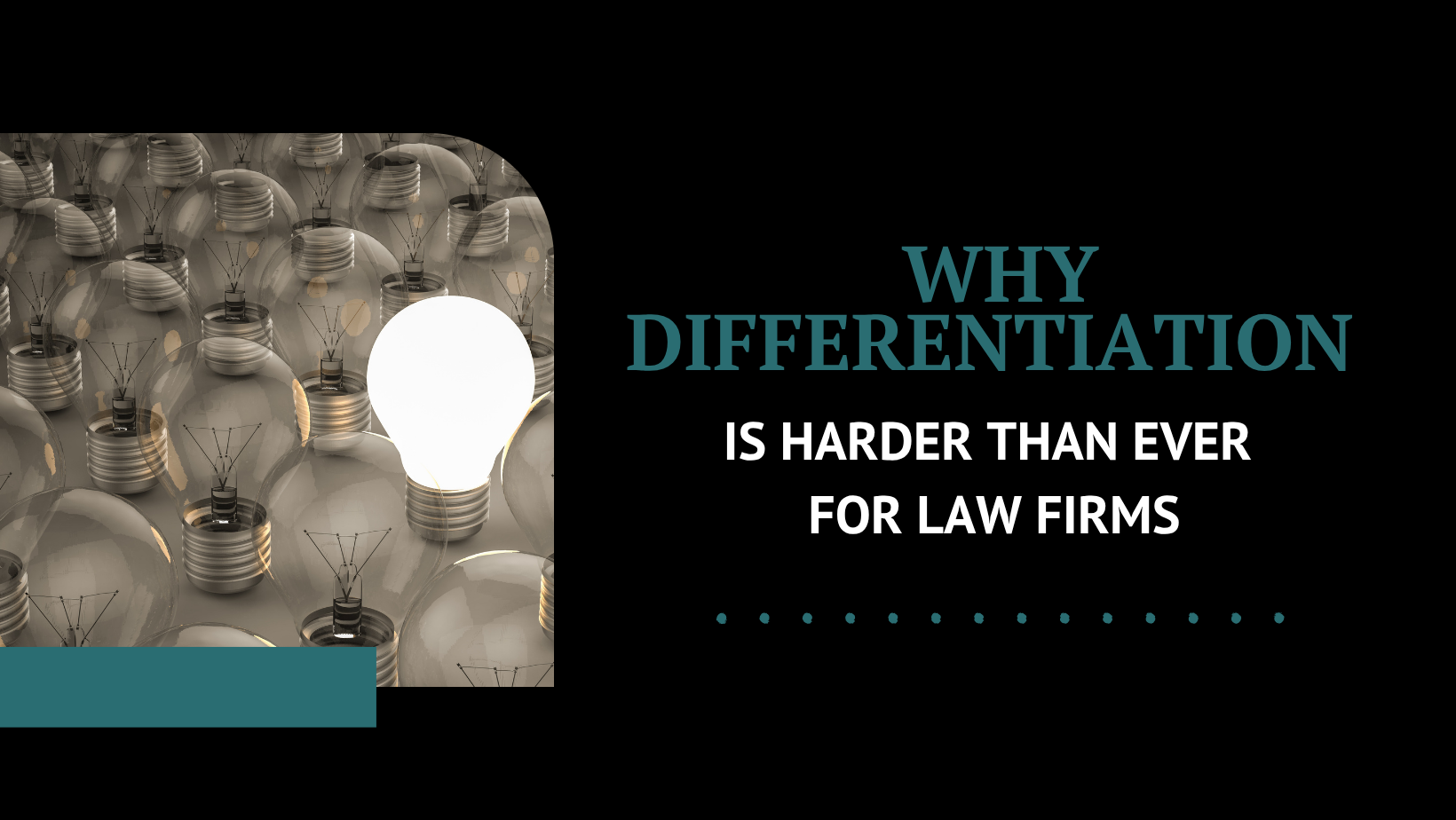
Ask a group of lawyers what makes their firm different, and many will give remarkably similar answers.
“We care about our clients.”
“We provide personalized service.”
“We communicate clearly.”
“We fight for results.”
The problem isn’t that these statements are wrong.
The problem is that nearly everyone says them.
That creates a growing challenge in legal marketing. Differentiation has become harder than ever. Prospective clients are exposed to countless law firm websites, advertisements, social media profiles, and online reviews. Much of it sounds the same.
As competition increases and marketing becomes more accessible, standing out requires more thought than simply creating a professional website and listing your credentials.
The Internet Made Everyone Look Similar
Twenty years ago, simply having a professional website could create separation.
Today, almost every law firm has one.
Website platforms are easier to use. Marketing templates are widely available. Design standards have become more consistent.
As a result, many firms end up with websites that look and sound remarkably alike.
Common elements include:
- Similar layouts
- Similar service pages
- Similar calls to action
- Similar messaging
From a prospective client’s perspective, distinguishing between firms often becomes difficult.
The easier marketing becomes to produce, the harder it becomes to stand out.
Most Firms Emphasize the Same Strengths
Another challenge is that lawyers often promote qualities that clients already expect.
For example:
- Professionalism
- Responsiveness
- Experience
- Dedication
These are important traits.
But they rarely create differentiation because clients assume competent lawyers should possess them.
Saying you’re responsive doesn’t separate you from competitors.
Showing how your client experience differs is often much more powerful.
True differentiation usually requires specificity.
Online Reviews Have Raised the Bar
Reviews have become one of the most influential parts of legal marketing.
The challenge is that strong reviews are no longer unusual.
Many firms have dozens—or even hundreds—of positive reviews.
That’s good for consumers.
But it also means reviews alone may not create meaningful differentiation.
Instead, prospects often look deeper:
- What do reviews consistently mention?
- What themes appear repeatedly?
- Does the experience sound different from competitors?
The conversation has shifted from “Do you have reviews?” to “What story do those reviews tell?”
Information Is Easier to Compare
Potential clients can now evaluate multiple firms within minutes.
They can:
- Compare websites
- Read reviews
- View attorney profiles
- Research credentials
This transparency is valuable.
It also means weaknesses become easier to spot and similarities become more obvious.
A prospective client may compare five firms before making contact.
If all five present nearly identical messaging, the decision becomes harder for everyone involved.
AI and Content Saturation Add New Challenges
Content marketing remains valuable.
But the internet is flooded with legal content.
Many articles cover the same topics using nearly identical language.
The rise of AI-generated content has accelerated this trend.
Publishing content is no longer enough.
The firms gaining attention are often the ones providing:
- Better explanations
- More useful insights
- Clearer answers
- Stronger perspectives
Volume alone creates less advantage than it once did.
Differentiation Is Not Always About Practice Areas
Many lawyers assume differentiation requires focusing on a niche.
Sometimes that’s true.
But differentiation can come from other places as well.
For example:
- Client experience
- Communication style
- Community involvement
- Industry knowledge
- Process efficiency
- Educational approach
Clients often care as much about how you work as what you do.
A unique client experience can be more memorable than a unique practice area.
Authenticity Matters More Than Positioning Statements
Some firms spend enormous effort creating positioning statements.
Yet the strongest differentiation often comes from authentic characteristics already present within the business.
Questions worth asking include:
- What do clients consistently praise?
- Why do referral partners send people to you?
- What type of matters do you handle best?
- What do you genuinely enjoy doing?
The answers often reveal differentiators that marketing alone cannot manufacture.
Authenticity tends to be more sustainable than forced branding.
Differentiation Requires Consistency
One overlooked reality is that differentiation only works when it is consistently reinforced.
If your website says one thing, your reviews suggest another, and your intake experience delivers something different, confusion follows.
The strongest brands create alignment between:
- Messaging
- Client experience
- Reviews
- Content
- Reputation
When all of those elements point in the same direction, differentiation becomes much easier for prospects to recognize.
Standing Out Doesn’t Mean Being Loud
Many firms think differentiation requires dramatic branding.
It doesn’t.
Often, standing out comes from being clearer, more specific, and more consistent than competitors.
The goal is not to be memorable for the sake of being memorable.
The goal is to help the right clients quickly understand why they should choose you.
That requires substance, not gimmicks.
Differentiation has become more difficult because legal marketing is more crowded, more accessible, and more competitive than ever before. The firms that succeed are usually not the ones chasing attention. They are the ones communicating a clear and authentic message that clients can easily understand.
If you want more practical marketing insights like this, keep reading Legal Marketing Blog. We focus on helping law firms build marketing strategies that stand apart for the right reasons.